

Where does 41-year-old LeBron James rank as an all-time Sixer?

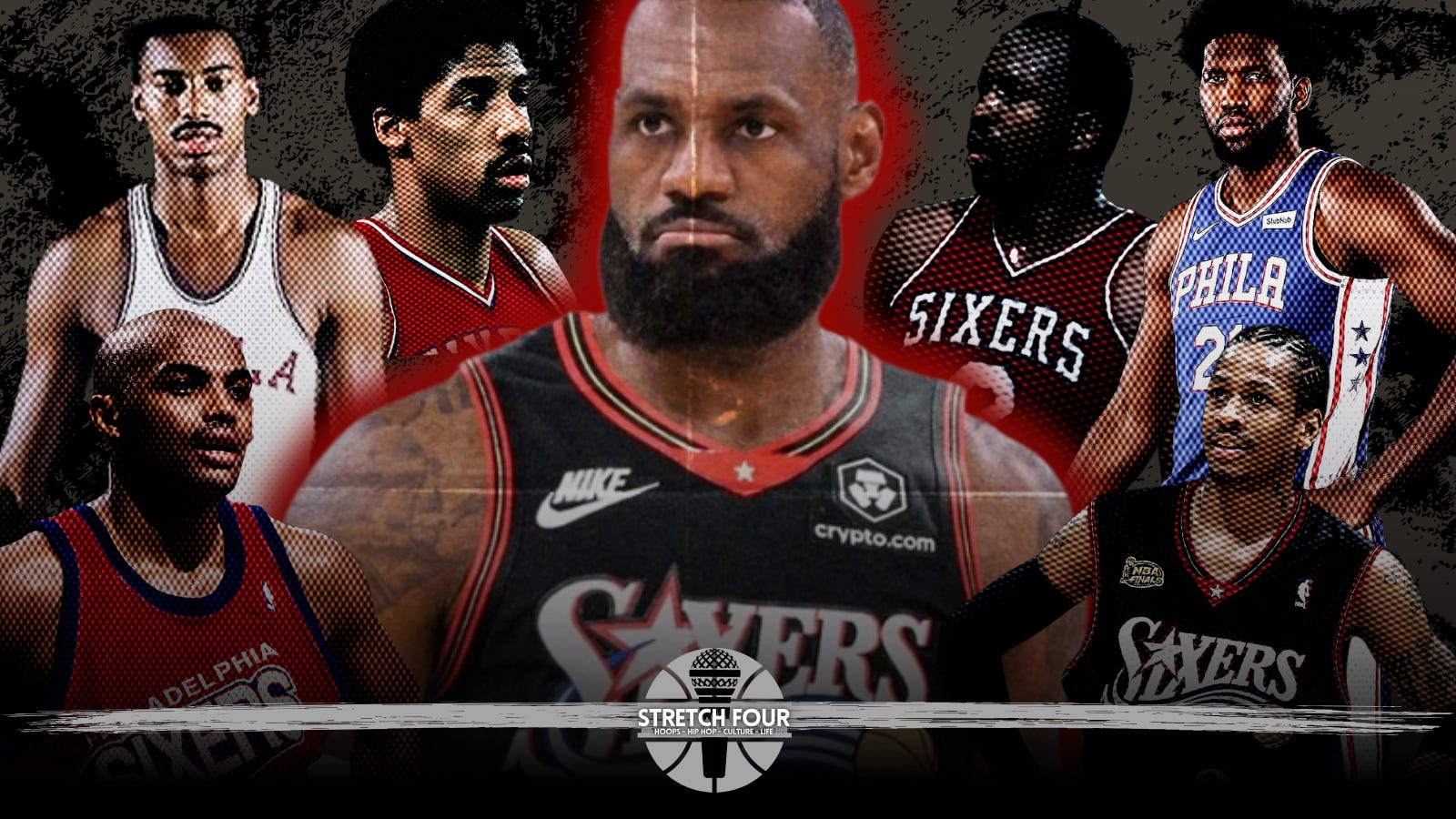
The Philadelphia 76ers just signed one of the greatest basketball players of all time1. They’re not getting 2007 LeBron James, capable of dragging an unlikely Cleveland Cavaliers team to the NBA Finals practically singlehandedly. They didn’t land 2012-13 LeBron James, who led Miami’s power trio to back-to-back titles. They haven’t signed 2016 LeBron James, who upset the greatest regular-season team of all time in the NBA Finals to bring the first championship to the city of Cleveland in over 50 years. They’re not even bringing in the 2020 LeBron, who won a title for the Lakers in the NBA Bubble.
Lucky for the Sixers, they don’t need any of those versions of LeBron James. It would be nice to have any of those, that’s for sure. But they’ll take what they can get, and that’s a 41-year-old who is still generally considered to be one of the top 20 players in the NBA.
Adding James to the list of NBA greats who have spent part of their careers as a Sixer has the internet asking if Philadelphia now boasts the most impressive all-time roster of talent in the history of the league. That’s not exactly fair, because they’re not adding peak LeBron to their lineup2. It does make me wonder where this version of LeBron ranks amongst the greatest players to ever wear a Sixers uniform. So I looked into it.
First things first:
What can the Philadelphia 76ers expect from a 41-year-old LeBron James?
The Sixers are adding a borderline top-20 player to their already potent lineup that features Tyrese Maxey (ranked 15th by The Ringer), Jaylen Brown (14), Joel Embiid (43rd, though the fully healthy dream of him is more like a top-10 guy) and VJ Edgecombe (ranked 84th at the end of last season by the panel at The Ringer). On this team, LeBron doesn’t have to be the guy, or even the second guy. On a totally healthy team, he doesn’t even have to be the third guy. What he can do is be a facilitator, a playmaker, and exploit mismatches all over on the offensive end of the floor. He can allow Tyrese Maxey to play off the ball, running his defender ragged with constant movement. And, of course, he can also take over in spurts from time to time when the matchup is right, and he’s feeling it.
Last season, James averaged 20.9 points, 6.1 rebounds, and 7.2 assists in 33.2 minutes per game in 60 appearances for the Lakers. He shouldn’t have to play that many minutes (or that many games) for the Sixers. There’s a good chance he averages fewer than 20 points per game for the first time in his 24-year career (this feels absolutely ridiculous to type). He very well could possibly (if he played enough to qualify) lead the league in assists with the level of talent he has around him and the role he might fill3.
He also just proved that he can still be the best player on a team that wins a playoff series - as he led the undermanned Lakers to a first-round victory over the Rockets. He can still reach that type of level when/if needed, which, hopefully, will never happen in Philly (unless it’s just for a few possessions in the right situations).
How am I ranking players?
I’m not trying to break down 10 different individual seasons and say that 41-year-old LeBron James is better than an X-year-old Julius Erving but not better than a Y-year-old Julius. That’s preposterous. I’m going to lean towards the peak performance of each player during their time with the Sixers and also generally where they rank in terms of the hierarchy of the league. It’s (mostly) accepted that players today are more skilled than those of the past and also they are able to extend their careers with better training, nutrition, and recovery (and, in the case of James, some sort of divine blessing). I’ll still take skill into account at least in a relative sense - where do they rank against the rest of the league in the era in which they played. I’m mainly focused on a player and their abilities in a vacuum; I’m not taking into consideration team-building, fit, salary, external factors, or anything else.
I think that mostly explains how I’m thinking here. So let’s put some players into tiers.
MVP-Level Sixers
I think it’s safe to say that LeBron James is no longer an MVP-level player. If so, I don’t think he’d be joining any team on a minimum contract. He certainly brings a ton of value, in a financial sense, to the team, and its city, but on the floor, I don’t think he’ll be threatening to win his fifth MVP award. I keep saying “I don’t think” and every time I write it, a little part of me deep down yells out from the bottom of a delusional-fan well, “what if?”
But I think it’s safe to say the following Sixers rank higher4 than 41-year-old LeBron:
Wilt Chamberlain: I’m sticking to his time with the Philadelphia 76ers (and not his time in the city with the Warriors), which only lasted three-and-a-half seasons from 1964-65 to 1967-68. In those 277 games, Wilt averaged 27.6 points, 23.9 rebounds, and 6.8 assists per game and won three straight MVPs from 1966-68.
Julius Erving: Dr. J averaged 22.0 points, 6.7 rebounds, and 3.9 assists per game in his 11 years with the Sixers, peaking (individually) with his MVP season in 1980-81, and co-anchoring the 1983 championship team with Moses Malone. Erving also had four other top-five MVP finishes in his time with the team, two more top-ten finishes, seven All-NBA team appearances (five first team, two second team), and never missed being named an All-Star (which counts a little less in terms of overall skill, as the late-career ASGs are mostly a legacy vote for all-timers like Doc.)
Moses Malone: Malone joined the Sixers as reigning MVP, went back-to-back (while also leading the team to the championship) in his first year with the team, and was probably the best player in the world for a brief stint while Kareem was a bit too old for it (while still great) and Magic and Bird were a little bit too young.
Allen Iverson: When LeBron dragged the 2007 Cavs to the NBA Finals, it was compared to Iverson doing the same with the 2001 Sixers. While prime LeBron might be able to do the same with AI’s supporting cast, 41-year-old LeBron would have a pretty tough time (see, last year’s Lakers without Luka and Austin Reaves).
Joel Embiid: The greatest Sixer of my basketball-watching lifetime. And at his peak, when fully healthy, I don’t think it’s even close.
All-NBA Level Guys
LeBron didn’t make an All-NBA Team last year, for the first time in…hold on…checking to make sure this is correct…good lord...get ready for this…TWENTY ONE YEARS. That’s right, LeBron has been an All-NBA member for every season of his career except for his rookie year and 2025-26. He technically did not make the cut to be named All-NBA because he only played 60 games last season. But he could have been a borderline Third Team player if he did qualify. Most likely not, but he might have gotten some votes.
That’s what we’re dealing with here. A borderline All-NBA level player who can still drag a team to a playoff series victory as the number one guy. We’re most likely going to draw the line of where LeBron as a Sixer ranks sometime soon. Which is crazy. The man is 41-years-old.
Charles Barkley: Barkley was the best basketball player in the world for one full year, starting with the 1992 Olympics and ending with his MVP campaign in the following NBA season. It’s too bad (and also not a coincidence) that was the first season after the Sixers traded him to Phoenix, where he led the Suns to an NBA Finals appearance. Even though the Sixers didn’t get Barkley at his absolute apex, they had him for three top-five MVP finishes and seven All-NBA nods (four first-team, three second-team).
Tyrese Maxey & Jaylen Brown: LeBron’s new teammates are reigning members of the All-NBA Team (Brown second-team, Maxey third) and at this point in their respective primes are probably both better than current LeBron James But…not by a whole lot…and mostly based on their overall availability. If we’re looking at pure peak performance in short bursts, LeBron still gives them a run for their money. I know the Lakers got swept by OKC in the second round and that Houston was a bit of a dumpster fire…but I still can’t get over the fact that he was just the best guy on a second-round playoff team.
Now it’s starting to get hard.
Dikembe Mutombo: He was only a Sixer for a season-and-a-half, but in that time he was Defensive Player of the Year, and was a member of two All-NBA teams (one second-team, one third-team). He also helped the team make the NBA Finals. Is LeBron better than that at this point in his career? It’s close. Let’s keep going for a little while.
Ben Simmons: Things really went off the rails for him, but at one point he was a First-Team All-Defensive player (runner-up for DPOY honors) and Third-Team All-NBA.
George McGinnis/ Billy Cunningham/ Hal Greer/ Larry Costello/ Dolph Schayes: You have to go back to the 1960’s and 70’s for the next crop of Sixers who made All-NBA teams, and they’re a bunch of guys I’ve never actually seen play. This is where the “modern NBA skills obviously dominate skills from 50-plus years ago” butts heads with the “I’m trying to take their standing in the league at the time into consideration”.
For example: Schayes finished in the top-ten for MVP voting six times…at a time when the league only had eight teams. How can you possibly compare that to today? I think I’m going to disqualify him from being a better “Sixer” than LeBron on the technicality that he was actually a Syracuse National, and even though that’s the same franchise, I’m using it as my excuse.
Billy Cunningham was a four-time All-NBA player in a pre-merger league, left to join the ABA and the Carolina Cougars, where he’d win league MVP in 1973, and returned to the Sixers for the 1974-75 campaign. He peaked statistically as a Sixer with 26.1 points and 13.6 rebounds per game, but that was in 1969-70 before we can even use statistics based on league-adjusted pace. I think if you played in an era before we figured out how to properly calculate basketball, you’re also disqualified (which includes Hal Greer and Larry Costello as well).
George McGinnis joined the Sixers in 1975-76 as reigning ABA MVP (one season before Julius Erving would do the same) and was immediately a top-five MVP finisher in the NBA. He spent three seasons with the team, making two All-NBA appearances. He has impressive stats during a time when teams were averaging a much faster pace, and LeBron’s Box Plus-Minus of 3.5 in 2025-26 (a stat that rates a player’s contribution to their team relative to league average in that particular season) is higher than McGinnis’ peak of 3.3 as a Sixer in 1975-76.
So where does 41-year-old LeBron James rank in terms of All-Time Philadelphia 76ers?
Somewhere at the bottom of the top ten. Right around Dikembe Mutombo/Ben Simmons. If I had to give him an exact spot, I’d put him above Simmons and…ugh…this is hard…also above Dikembe Mutombo. Even though he was DPOY and Second-Team All-NBA, I don’t think Dike could drag a team to a playoff series victory singlehandedly.
41-year-old LeBron James is the ninth best Sixer of all-time5. And three of them are still on the team, ahead of him6. Get excited.
If you ask me, the greatest.
Though if you’re going by each player’s overall career, the Sixers were already one of the best all-time franchises before adding the player with the greatest resume in league history.
Yeah, that’s right, filling a role. What a concept! I’m looking at all of you “there’s only one ball” naysayers doing clown-ass things like adding up the usage rates and pointing to a number over 100, who clearly don’t know how to play winning team basketball. Lucky for the Sixers, LeBron very much does.
I am choosing to list them in chronological order instead of making myself rank the top five Sixers of all-time. This is the top-five, they’re just not ranked. Please don’t make me do it.
Please, don’t be mad that I didn’t mention Jimmy Butler/James Harden/Paul George. LeBron is definitely better than all of them during their run with the Sixers.
I know that 2026 Embiid isn’t MVP-level Embiid, but…what if?